
Guitar Strap Width Guide: Why It Matters More Than You Think

If your shoulder's been aching after practice, you've probably blamed your posture, your guitar, or just getting older. Before you go down that road — check your strap. Width is the single biggest comfort factor in a strap, and it's the one thing most players never think about until it's a problem.
Here's what you actually need to know.
What Guitar Strap Widths Are Available
Straps generally run from about 1 inch up to 4 inches wide. Most players end up somewhere in the middle without ever really thinking about why. The short version: narrow straps move with you, wide straps carry weight for you. Neither is "correct" — it depends on your guitar and how you play.
Why Width Affects Shoulder Comfort
It comes down to basic physics. A wider strap spreads your guitar's weight across more surface area, so there's less pressure on any one spot on your shoulder. A narrow strap puts that same weight into a smaller line across your shoulder, which is exactly why thin straps start to dig in on longer sessions — especially with a heavier guitar.
This is why we build our straps the way we do. We're not chasing one "best" width — we make three, because different guitars and different players genuinely need different things.
Matching Strap Width to Your Guitar's Weight
Here's the rule of thumb: the heavier the guitar, the more width (or padding) you want backing it up. A Les Paul or a heavy hollow-body bass is going to want more surface area than a lightweight offset. Go too narrow on a heavy guitar and you'll feel it — not just in your shoulder, but in neck dive too, since a strap that can't hold its position lets the headstock drift down all night.
Lighter guitar? You don't need to overcompensate. A wide strap on a light guitar isn't wrong, but it can feel like overkill and get in the way if you move around a lot.
What We Actually Make (and Why)
We keep it simple — three widths, each built for a different job:
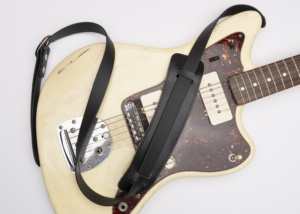
Slim guitar strap
1" slim, with shoulder pad — this is our 60's-style belt strap. On paper, 1 inch sounds too thin for comfort. In practice, the shoulder pad does the job that width normally does — it's the trade-off that lets you get the vintage look without the narrow-strap dig. Best for lighter guitars and players who want that retro low-profile feel over maximum cushioning.
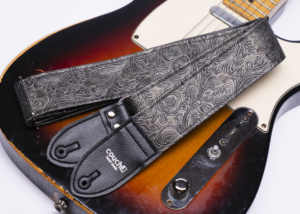
Graphite Western Guitar Strap
2" standard — our all-purpose width. This is the one most players should default to. It works across most electrics and acoustics and hits the balance between comfort and a classic look.

3 inch wide guitar strap
3" padded — built for heavier guitars and long sets. Maximum surface area, maximum cushioning, least fatigue. If you're gigging for hours or you already deal with shoulder issues, this is the one.
How to Find Your Right Width
- Weigh your guitar, or check the spec sheet if you don't have a scale handy.
- Guitar's under about 7 lbs and you want that vintage look? Our 1" slim works fine — the shoulder pad's doing the heavy lifting.
- Not sure, or playing a standard electric/acoustic? Go 2" standard. It's the safe default for a reason.
- Guitar's 8+ lbs, you're playing long sets, or your shoulder's already telling you something? Go 3" padded.
- These are starting points, not rules. Try one on before you commit — comfort is personal.
Width Isn't the Whole Story
Width gets you most of the way there, but padding and material matter too — that's a big part of why our 3" strap and our 1" strap solve the same problem (comfort) in completely different ways. We'll dig into materials — leather, vegan alternatives, vintage fabric — in upcoming posts, so keep an eye out if you're deciding what your strap's actually made of, not just how wide it is.
FAQ
What's the best guitar strap width for a Les Paul? Go wide — a 3" padded strap will distribute the weight and cut down on neck dive a lot better than anything narrower.
Does a wider strap really reduce shoulder pain? Generally, yes — more surface area means less pressure on any one point of your shoulder. The exception is a narrow strap with real padding built in, like our 1" shoulder-pad strap, which solves the same problem a different way.
Is a 1-inch guitar strap too narrow? Not if it's padded right. Our 1" slim comes with a shoulder pad specifically to make up for the narrower webbing — it's built for lighter guitars and a vintage look, not for hauling around a heavy bass all night.
Got a shoulder that's been bothering you, or a guitar that just never sits right? Let us know what you're playing and we'll help you figure out which width makes sense. Or just check them out and feel the difference yourself.